Posts

Hemoglobin and osteoblasts markers in bone cancer, ISSN 2753-8176 (online), DOI: 10.13140/RG.2.2.14509.05606
Image
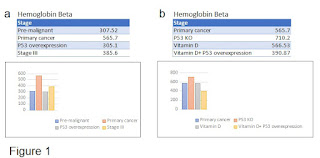
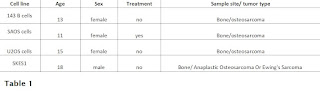
Hemoglobin and osteoblasts markers in bone cancer Ana Pedro (1) 1. Gwyntwr1386 Pharmacy, Regus Chester Business Park, Heronsway,Chester CH4 9QR, United Kingdom info@gwyntwr1386.com Osteosarcoma is a type of bone sarcoma or primary bone cancer which usually develops in growing bones and can affect any bone although most common areas are the arms or legs. It is most often found in teenagers and young adults, although it can happen at any age. Around 1 in 10 osteosarcomas (10%) develop in adults in their 60s and 70s (1). Ewing tumors, however can start in either the bone or the soft tissue (2). Here, we analyzed by proteomics analysis, the content of the precipitates derived from the ultracentrifugation of conditioned media derived from the cell culture of different bone cancer cell lines (table 1, 3-6). We found out that a set of different hemoglobin subunits and osteoblast markers express differently in these different bone cancer cell lines (Table 2, 7) In summary, while cell...

Hemoglobin in Head and Neck cancer - Short report (ISSN 2753-8176 (online), DOI: 10.13140/RG.2.2.16792.67846

Image
Ana Pedro (1) 1. Gwyntwr1386 Pharmacy, Regus Chester Business Park, Heronsway,Chester CH4 9QR, United Kingdom info@gwyntwr1386.com Squamous-cell carcinoma (SCC ), also known as epidermoid carcinoma, comprises a number of different types of cancer which begin in squamous cells (1). Squamous cells are present on the surface of the skin, on the lining of hollow organs in the body, and on the lining of the respiratory and digestive tracts (1). About 90% (2) of cases of head and neck cancer (cancer of the mouth, nasal cavity, nasopharynx, throat and associated structures) are due to SCC. The most common types of head and neck cancers occur in the lip, mouth, and larynx (3). We analyzed by proteomics the conditioned media precipitates of two different samples of head and neck cancer samples culture, M2 and M9 (table 1). We found that hemoglobin beta and hemoglobin delta are consistently found in both samples with significant Mascot scores. Materials and Methods Proteomic analysis was ...

Hemoglobin in Lung Cancer - Short report (ISSN 2753-8176 (online), DOI: 10.13140/RG.2.2.30186.59842

Image
Ana Pedro (1) 1. Gwyntwr1386 Pharmacy, Regus Chester Business Park, Heronsway,Chester CH4 9QR, United Kingdom info@gwyntwr1386.com There are two main types of lung cancer , categorized by the size and appearance of the malignant cells, small cell lung cancer (SCLC; 15% of lung cancer diagnoses) and non-small cell lung cancer(NSCLC; 85% of diagnoses) (1). Here we analyze by proteomic analysis, the precipitates derived from conditioned media of different lung cancer cell lines (2-7), all NSCLC and also derived from the culture of a bone metastases from lung cancer sample. In what concerns, adenocarcinomas, HBB (hemoglobin beta) and HBA (hemoglobin alpha) scores raise from primary cancer to lymph node (LN) metastases (Table 1). HBG2 (hemoglobin gamma-2) may appear with a NS (non-significant) score in primary cancer, but becomes significant in LN metastases (mets). In other NSLCs types, HBB score raises from primary cancer to LN metastases. Finally, bone metastases, show a spectacula...

Hemoglobin in Prostate Cancer (ISSN 2753-8176 (online), DOI: 10.13140/RG.2.2.14314.59847

Image
Hemoglobin in Prostate Cancer (ISSN 2753-8176 (online), DOI:10.13140/RG.2.2.14314.59847 Small report Ana Pedro (1) 1. Gwyntwr1386 Pharmacy, Regus Chester Business Park, Heronsway,Chester CH4 9QR, United Kingdom info@gwyntwr1386.com Prostate cancer is the second most common type of cancer in the world. Moreover, is the fifth leading cause of cancer-related mortality among men (1). About 99% of cases occur after age 50 (2). Early prostate cancer symptoms are often similar to those of benign prostatic hyperplasia and include frequent urination, nocturia (increased urination at night), difficulty starting and maintaining a steady stream of urine, hematuria (blood in the urine), dysuria (painful urination) as well as fatigue due to anemia, and bone pain (3). Like early cancer, metastic prostate cancer often causes bone pain, often in the vertebrae, pelvis, or ribs (4). By proteomics analysis of cell conditioned media precipitates, derived from cell culture of pro...

Hemoglobin in gastric cancer (ISSN 2753-8176 (online), DOI:10.1101/202291v1 , Small report

Image
Hemoglobin in gastric cancer (ISSN 2753-8176 (online), DOI:10.1101/202291v1 Small report Ana Pedro (1) 1. Gwyntwr1386 Pharmacy, Regus Chester Business Park, Heronsway,Chester CH4 9QR, United Kingdom info@gwyntwr1386.com Gastric cancer is a cancer which develops from the lining of the stomach(1). The majority of the cases are gastric carcinomas, which can be divided into a number of subtypes, including gastric adenocarcinoma (2) Unfortunately, early gastric cancer causes few symptoms and the disease is usually advanced when the diagnosis is made being difficult to treat.(3) We analyzed by proteomics the secretion of different hemoglobin by different gastric cancer cell lines derived from primary tumor tissues (4) or lymph node metastases (5) or stage IV tumors (6) in cell culture. We found out that (table 1 and fig.1), hemoglobin subunit gamma-2 (HBG-2) is present in both primary cancer (SNU1) and lymph node (LN) metastases (HGC27)...

Hemoglobin in colorectal cancer (DOI: 10.13140/RG.2.2.32515.99363, ISSN 2753-8176 (online))

Image
Hemoglobin in colorectal cancer Ana Pedro (1) 1. Gwyntwr1386 Pharmacy, Regus Chester Business Park, Heronsway,Chester CH4 9QR, United Kingdom anapedrolaboratories@gmail.com Colorectal cancer (CRC), also known as bowel cancer, colon cancer, or rectal cancer, is the development of cancer from the colon or rectum (parts of the large intestine)(1) Staging of the cancer is based on both radiological and pathological findings. As with most other forms of cancer, tumor staging is based on the TNM system which considers how much the initial tumor has spread and the presence of metastases in lymph nodes and more distant organs (2). While 30% at the patients will actually benefit from adjuvant treatment, 50% of them being already cured by the surgery and 20% of them will experience disease recurrence despite the adjuvant treatment (3) . Also, anemia is the only finding that correlates with highly advanced CRC, in the pre-operative stage (4). Tumor cells are found to secr...

Hemoglobin in Pancreatic Cancer – short report, ISSN 2753-8176 (online), DOI: 10.13140/RG.2.2.20722.79043

Image
Hemoglobin in Pancreatic Cancer – short report, ISSN 2753-8176 (online), DOI: 10.13140/RG.2.2.20722.79043 A na Pedro (1) 1. Gwyntwr1386 Pharmacy, Regus Chester Business Park, Heronsway,Chester CH4 9QR, United Kingdom anapedrolaboratories@gmail.com S ome cancer cell types such as from prostate, lung and breast cancers might express hemoglobin beta , which might be a defense mechanism of tumor cells against intracellular reactive oxygen species (ROS) (1). We examine the presence of hemoglobin subunits in different types of pancreatic adenocarcinoma cell lines cell culture conditioned media (CM)(https://zenodo.org/record/7339463#.Y3pC5XbP3IU). The most common of pancreatic cancer (PC) is adenocarcinoma, accounting for about 90% of cases. Around 1–2% of cases of PC have a neuroendocrine origin , arising from the hormone-producing cells of the pancreas. These tumours in general are less aggressive than pancreatic adenocarcinoma. PanIN (pancreatic intraepithelial neoplasia, a histo...